If you see translation errors, please write to us on the forum about them.
Sociometric Indices
There are two types of sociometric indices:- Personal sociometric indices;
- Group sociometric indices.
The former characterize the individual socio-psychological properties of an individual as a member of a group. The latter provide numerical characteristics of the overall sociometric configuration of choices within a group. They describe the properties of group communication structures.
1. Personal sociometric indices
The main personal sociometric indices are:
- sociometric status index of the i-th member;
- emotional expansiveness index of the j-th member;
- volume index of intensity and concentration of interaction of the ij-th member.
The symbols i and j denote the same group member, but in different roles:
- i – object of choice;
- j – subject of choice;
- ij – combination of roles.
1.1. Sociometric status index of the i-group member
Sociometric status is the property of an individual, as an element of the sociometric structure, to occupy a certain spatial position (locus) within it, i.e., to relate in a certain way to other elements. This property is developed unevenly among the elements of the group structure and, for comparative purposes, can be measured by a number – the sociometric status index. The elements of the sociometric structure are individuals, members of the group. Each of them interacts with each other to some extent, communicating, directly exchanging information, etc. At the same time, each group member, being part of the whole (the group), influences the properties of the whole through their behavior. This influence is realized through various socio-psychological forms of mutual influence. The subjective measure of this influence is emphasized by the magnitude of sociometric status. However, an individual can influence others in two ways – either positively or negatively. Therefore, it is customary to speak of positive and negative status. Status also measures a person's potential for leadership. To calculate sociometric status, it is necessary to use sociomatrix data.
The sociometric status index of a group member is determined by the formula:
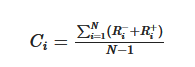
where Ci is the sociometric status of the i-member, Ri is the elections received by the i-member, ∑ is the sign of the algebraic summing the number of votes received for the i-th member, N is the number of group members.
It is possible to calculate C+ (positive) and C– (negative) status in small groups (N).
1.2. Emotional expansiveness index of the j-group member
The emotional expansiveness index of the j-member of the group is calculated using the formula:
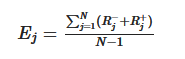
where Ej is the emotional expansiveness of the j-member, R is the choices made by the j-member (+, –).
From a psychological perspective, expansiveness characterizes a person's need for communication.
2. Group sociometric indices
Among the group sociometric indices, the most important are:
- Group Emotional Expansiveness Index;
- Group Psychological Reciprocity Index (Group Cohesion);
2.1/ Group Emotional Expansiveness Index
The group emotional expansiveness index is calculated using the formula:

where Ag is the group's expansiveness, and N is the number of group members.
The index shows the average activity of a group when solving a sociometric test task (per group member). This formula allows us to understand how actively group members are involved in the interaction process.
Interpretation of the group emotional expansiveness index
Ag shows the average number of choices made by one group member.
- Ag = 0 — the members made no choices.
- Ag = 1 — on average, each member made one choice.
- Ag = 2 — on average, each member made two choices, and so on.
The higher Ag is, the more choices the members make on average. The study conditions and any limit on the number of choices must be taken into account when interpreting the value. A high or low Ag value alone is not an assessment of the quality of relationships or group cohesion.
2.2/ Index of psychological reciprocity in a group
The index of psychological reciprocity ("group cohesion") in a group is calculated using the formula:
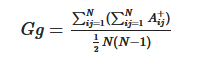
where Gg – reciprocity in a group based on the results of positive elections, Aij+ is the number of positive mutual ties in the group, N is the number of group members.
The cohesion index shows the proportion of pairwise mutual ties in a group relative to the theoretically possible number of such ties.
Interpretation of the psychological reciprocity index (density of mutual positive ties)
Gg ranges from 0 to 1 and shows the proportion of all theoretically possible pairwise ties in the group that are mutual positive ties.
- Gg = 0 — no mutual positive ties were recorded for the criterion under study.
- The higher Gg is, the greater the density of mutual positive ties in the group.
- Gg = 1 — the theoretical maximum: every member has a mutual positive tie with every other member.
The Gg value should be interpreted together with the sociogram structure and other sociometric indicators. A low absolute index value alone does not mean that interaction or support between members is absent.
2.3/ Conflict Index
The conflict index characterizes the conflict potential of a group. It is symmetrical to the psychological reciprocity index and represents an index of negative reciprocity, indicating the presence and degree of mutually negative pairs. The presence of such pairs reduces the processes of structural consolidation and diminishes the group's ability to maintain equilibrium.
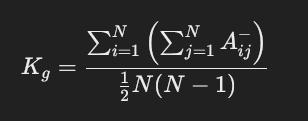
Interpretation of the conflict index
Kg shows the proportion of mutual negative ties relative to the theoretically possible number of pairwise ties in the group.
- Kg = 0 — no mutual negative ties were recorded for the criterion under study.
- The higher Kg is, the greater the density of mutual negative ties in the group.
- Kg = 1 — the theoretical maximum of mutual negative ties.
The index describes the structure of mutual negative choices, but by itself does not establish whether real interpersonal conflicts are present or absent. It should be considered together with the sociogram and other indicators.
2.4/ Group Reference Index (Group Satisfaction)
The higher the reference index, the closer the connections between the core group elements, whose behavior determines the processes of developing a sense of community. The index shows how satisfied group members are with their preferences. If is close to 1, then most of the participants' preferences are satisfied. If U is less than 1, some preferences remain unsatisfied.
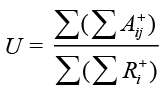
where is the sum of mutually positive choices in the group;
 sum of positive votes in the group.
Interpretation of the group reference (satisfaction) index
U shows the proportion of positive choices that are matched by mutual positive choices.
- U = 0 — none of the positive choices are mutual.
- U = 0.5 — half of the positive choices taken into account involve reciprocity.
- U = 1 — all positive choices taken into account are mutual.
The higher U is, the greater the reciprocity of the group members' positive preferences.
2.5/ Negative choice reciprocity index
Shows the proportion of negative choices that have a reciprocal negative choice. Unlike Kg, the denominator is the actual number of negative choices.
R− = 2M− / L−
M− is the number of mutual negative pairs; L− is the total number of directed negative choices. Each mutual pair is counted once and contains two choices.
0 — no negative choices are reciprocal; 0.5 — half are reciprocal; 1 — all are reciprocal.
The index is not calculated when there are no negative choices. For example, 10 negative choices and 2 mutual negative pairs give R− = 2 × 2 / 10 = 0.4. It describes reciprocity for the criterion studied and does not by itself indicate actual conflicts.