If you see translation errors, please write to us on the forum about them.
Major SocioMatrix.Online Update: New Group Indices, Automated Interpretation and Recommendations
We have released a series of updates to SocioMatrix.Online, focused on improving the accuracy, usability, and depth of sociometric analysis.
The most important new feature is automated interpretation of sociometric results, along with recommendations for working with groups.
SocioMatrix.Online now goes beyond calculating sociometric indicators, helping researchers and professionals better understand the structure of interpersonal relationships within a group.
Automated Interpretation and Recommendations
Starting with version 1.878b, sociometric reports include the first version of our rule-based interpretation and recommendation system.
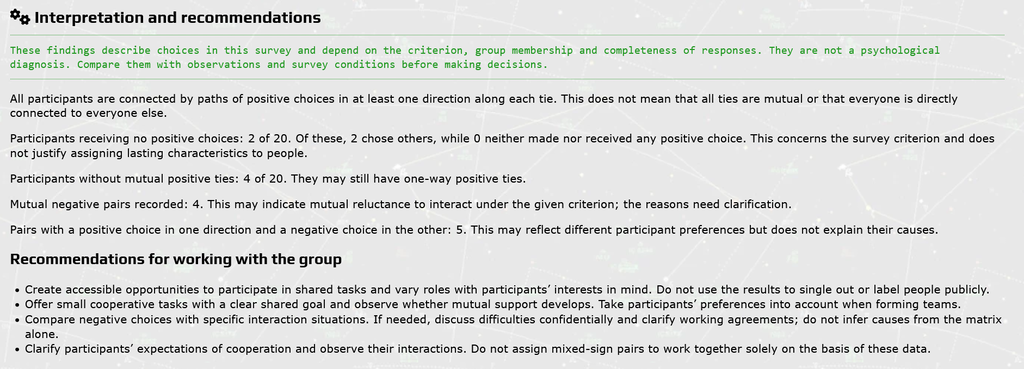
The analysis considers:
-
Connected components and the overall structure of the group.
-
Coverage of participants by positive and mutual choices.
-
Negative choices and contradictory relationships.
-
Exact relationship counts, avoiding inaccuracies caused by rounding calculated indices.
Based on these characteristics, the system generates explanations and practical recommendations for further work with the group.
All interpretations are generated using predefined algorithms and logical rules, without artificial intelligence.
This is the first version of the recommendation system. We plan to expand and refine it based on feedback from professionals using the service.
Six New Group Indicators
We have significantly expanded the set of indicators available for analyzing interpersonal relationships and group structure.
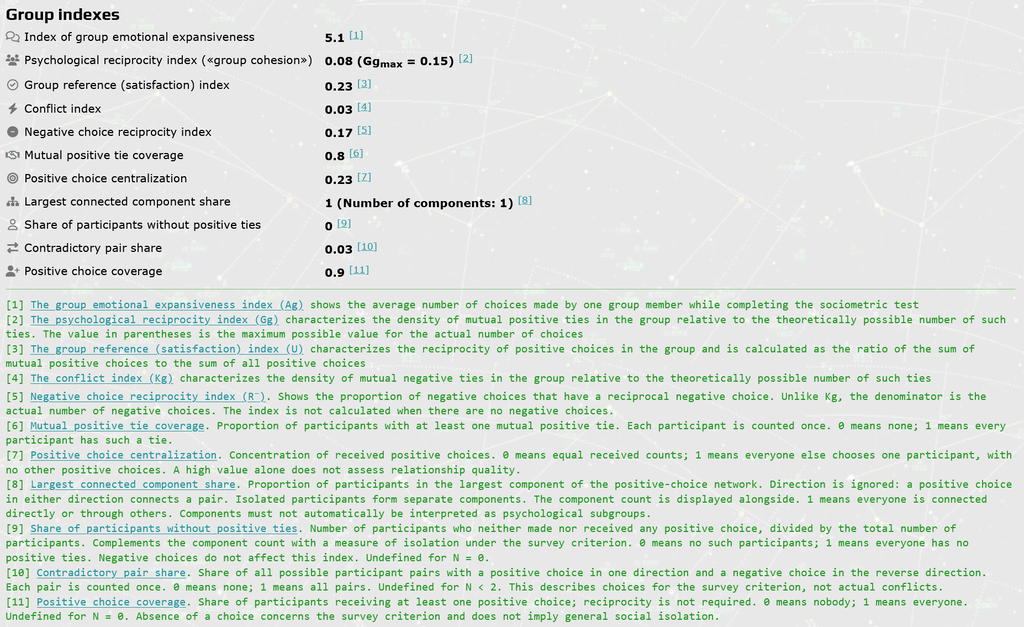
1. Negative Choice Reciprocity (R⁻)
Measures the degree of reciprocity in negative choices between group members.
2. Mutual Positive Relationship Coverage
Measures the proportion of participants involved in at least one mutual positive relationship.
3. Positive Choice Centralization
Describes how unevenly received positive choices are distributed among group members and the extent to which they are concentrated around particular individuals.
4. Largest Connected Component Share
Measures the proportion of group members belonging to the largest connected structure of positive relationships. The total number of connected components is also displayed.
5. Proportion of Contradictory Pairs
Measures the proportion of participant pairs in which one person makes a positive choice while the other makes a negative choice in return.
6. Positive Choice Coverage
Measures the proportion of group members who have received at least one positive choice from another participant.
These indicators complement traditional sociometric indices and provide additional insight into relationship reciprocity, choice distribution, group connectivity, and structural characteristics.
Explanations, formulas, and tooltips for the new indicators are available in all five supported languages.
Improved Group Index Interpretation
In version 1.866b, we revised and clarified the descriptions and interpretations of group-level sociometric indicators.
We also introduced Gg(max), representing the maximum possible value of the psychological reciprocity index based on the actual number of positive choices.
Additional improvements include clearer explanations, more consistent interpretation rules, and corrections to calculations for small groups.
Expanded Multilingual Documentation
Version 1.868b introduced expanded help documentation in Ukrainian, Romanian, and Dutch.
We improved descriptions of sociometric indicators, instructions for processing studies, and explanations of the results.
These improvements make SocioMatrix.Online more accessible to researchers and professionals from different countries.
Performance and Stability Improvements
Alongside the new analytical features, we have made several technical improvements:
-
Faster processing and display of sociometric results.
-
Improved report generation and saving.
-
Corrections to identified calculation issues.
-
Greater overall interface stability.
What's Next?
We will continue improving our rule-based interpretation system, expanding group structure analysis, and refining the recommendations provided in sociometric reports.
We especially welcome feedback from psychologists, educators, researchers, and other professionals who use SocioMatrix.Online in their work.
Your suggestions help us make the service more useful, accurate, and accessible.
Thank you for using SocioMatrix.Online and supporting its continued development!